I couldn’t get away from Genesis right now if I wanted to. My high school small group, the online Bible study I co-host, the chapel content at work, the articles friends are sending me, and the documentary Mark and I are watching at home. Genesis seems inescapable.
Focusing on beginnings at the end of a year seems a little odd to me, but at this point, ignoring repeated content is not an option.
I confess that I probably rarely give these foundational stories the thought and study they deserve simply because I’ve heard them for so long. If I want to do a Bible book study, I usually go for one of the Minor Prophets or letters of Paul — something short but sizable in terms of content. Genesis has half a hundred chapters.
Adam and Eve, Cain and Abel, Noah and his ark — the flannel boards, animated videos, memory verses, and coloring pages meld together in a “been there, read that” frame of mind — to my detriment. And to yours if you’re like me in this.
That’s because 2020 may be bringing us questions that have already been spoken into by Genesis, if we’d take the time to re-read and recall. In a time of such great and global unsettling, we may need to be redirected to our origins more than we realize.
Now may be the perfect time to remember that the earth was formless, void, and dark when God indwelt it (Gen. 1:2) — and He’s never left. Now may be the perfect time to remember that God speaks order into chaos (day 1 of creation). Now may be the perfect time to remember that God’s presence does not leave amid unexplained personal suffering (Joseph). Now may be the perfect time to remember that God sees successive centuries of oppression (the Israelites’ 400-year slavery in Egypt). Now maybe the perfect time to remember that what fueled Eve’s deception and Abraham’s faith-filled obedience was their views of God’s character. And our lives likewise depend on our view of His character.
2020 may already feel like a 12, even 13-month accident, but the loving, living God is still present in the sun that rises over wildfire-scorched land, in the protest-filled courtrooms and rubble-filled city streets, and in the rising of chests that struggle to breathe despite exponentially multiplying viruses.
We hear pieces of Genesis’ stories in conversations and sermons, names of the major characters that are supposed to jog our memories with some moral lesson. But do they? Do we see how they matter in the 21st century? Do we sit in them long enough to let ourselves be changed?
It wasn’t long after God delivered His people from their bondage in Egypt that He told them to set up monuments and symbols and fasts and festivals to remember all He had done for them. They needed reminders and re-education. And so do we.
Genesis shouldn’t be revered and studied simply because it is old, because it is wisdom-filled, or because it is the first book in the Bible. It should be honored and pored over because it is the breathing, active Word of God. It records the first time He spoke something into existence. He still speaks, and people and hearts and hopes and miracles still come to be. It all started here.
If during the next few weeks (or months or years) you ask me what I’m studying, I’ll probably say Genesis. Or the meaning of life. Same thing.
Remembering and re-learning Genesis because 2020 demands it,
Renée
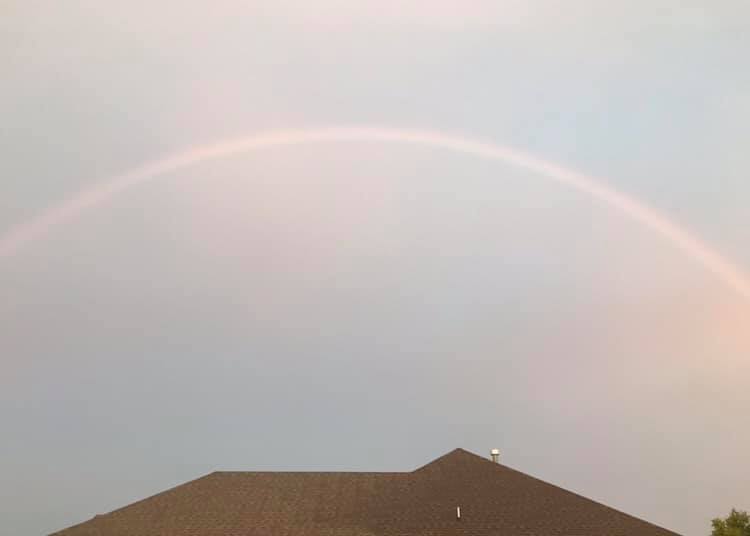
[Photo: In mid-September after my second quarantine (yes, I have had a few, and no, I have not been sick), I went on an early-morning bike ride to wake up and get ready for a week back at the office, and toward the end of the ride I looked skyward to find that I had stopped right under the center of a rainbow. Suddenly enveloped in a symbol of God’s covenant with every living creature (Gen. 9:13), I felt seen and assured of His mercy and faithfulness, come what may. I biked the three minutes home to take another photo, and the rainbow was gone.]