I’d like COVID-19 to kill my regret.
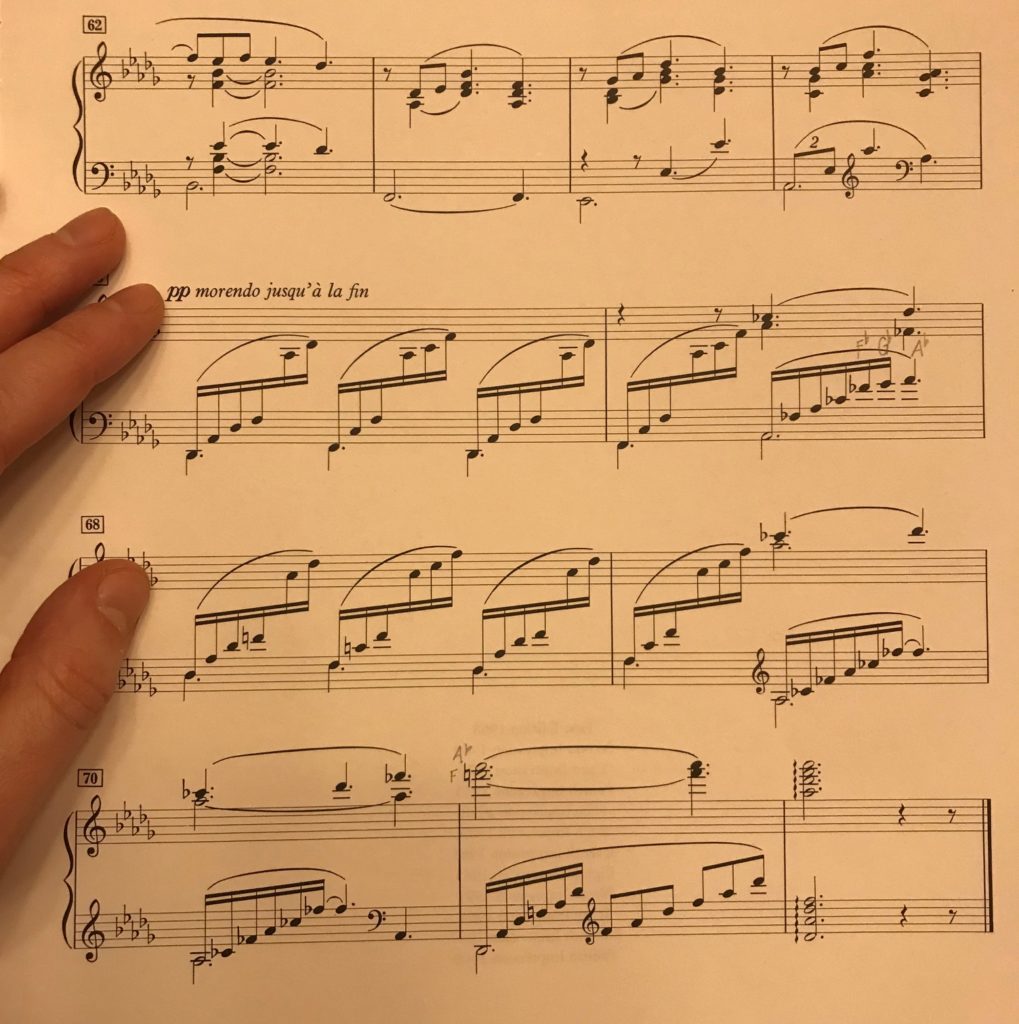
This week I dug “Clair de Lune” out of the piano bench and played it for the first time in years. I generally leave it alone since it reminds me of how, years ago, I brought the sheet music to my grandma’s funeral because it was her favorite classical song, but last minute I balked, too nervous to mess up on it in front of gathered guests, so I opted for a Brahms piece I knew much better. No one knew that song; most thought the funeral home was streaming canned background music. I felt safer—at the expense of bestowing messy sounds that would have connected people to the one they lost. The façade of safety quickly melted into a regret that still slugs me each time I play the last lines where the musical notation reads “morendo jusqu’à la fin,” meaning “dying away until the end.” That’s what regret feels like. It feels like living death.
COVID-19, despite its insidious prevalence, has given the gift of time to many of us. It has shut down our workplaces, reduced our meet-ups to video conferencing, transitioned our children to homeschool and our shopping carts to online ordering. I cannot count the number of times I pleaded with God in recent months, “If only I had a day at home! If only I had more time!” as my to-do list mounted and I sensed that my priorities were out of order. Now many of us have been dealt a slew of homebound days which, necessary ventures outside and workload demands notwithstanding, have put more time on our hands or at least given us a new normal. I now have the time I sighed for in early 2020.
How have I used it? Well, I can tell you that my Lenten devotional readings for the 40 days before Easter have gone out the window. I can tell you that there are some dishes in the sink. I can tell you that my assignments for both of my jobs are not being checked off swiftly. I can tell you I have a pile of laundry waiting for me in the other room…okay, two piles. I can tell you that—well, I’ll stop there. I think of “Dr. Heidegger’s Experiment,” a short story by Nathaniel Hawthorne I read in my junior year of high school. The doctor had discovered the Fountain of Youth, and he invited four of his aged friends to drink of it and see if it would make them young again. He first asked them to act virtuously in their second chance at life: “‘Before you drink, my respectable old friends,’ said he, ‘it would be well that, with the experience of a lifetime to direct you, you should draw up a few general rules for your guidance, in passing a second time through the perils of youth. Think what a sin and shame it would be, if, with your peculiar advantages, you should not become patterns of virtue and wisdom to all the young people of the age!’“ The friends laughed at how ridiculous a question was posed them. Of course they would act differently.
And then they didn’t.
They were carried away by the magical return of “the good ol’ days” and settled into behaving just as before. That was enough for Dr. Heidegger; he concluded his experiment by deciding never to drink from the Fountain.
And now my good intentions are brimming over as I stand on the brink of what I asked for: how will I use this time?
And how will you? This God-forsaken virus has freed us from the shackles of normalcy. It’s easier to do things differently when our foundation shakes and we have nowhere else to turn for hope and satiation except to God. But once our new normal “normalizes,” will we settle our same selves in? I’m finding in these past couple weeks that it takes more than a change of circumstances; it takes an internal revolution, a setting of heart that intentionally invests in the grace and the time and the space that has been freshly given us.
At this point, I couldn’t possibly ask for more time: I have all I need. And in the quiet moments of our contemplation, more often than not we might find that we have all we need for the tasks at hand. It just takes putting a hand to those tasks.
I’m going to play “Clair de Lune” a lot more. I’m going to quit filling space with meaningless action and invest in intercession, rest, and actions of substance. And I’m going to ask you to kill COVID-19’s deadening effects with me one intentional moment at a time.