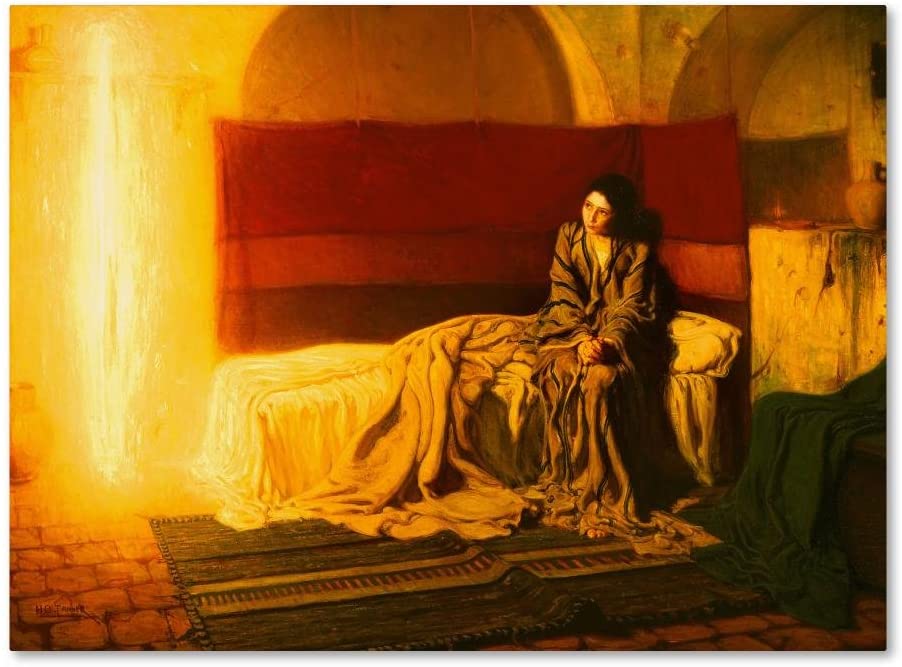
My favorite “Advent painting” is The Annunciation by Henry Ossawa Tanner. It’s unlike any painting of the Virgin Mary I’ve ever seen, and its artist is equally unlikely. He possessed and painted empathy on a new level.
Born 4 years before the Emancipation Proclamation, Tanner grew up in Pennsylvania to a mother who escaped the slave trade via the Underground Railroad and a college-educated father who became a bishop in the African Methodist Episcopal Church. As a young adult, Tanner went to Paris to study painting but returned to Philadelphia to be one of the few to paint his fellow African Americans in a positive light. Frederick Douglass said of Philadelphia: “There is not perhaps anywhere to be found a city in which prejudice against color is more rampant.” It came to the point where Tanner said, “I cannot fight prejudice and paint at the same time,” so he left, settling in Paris where he spent the rest of his life—except for his repeated trips to the Middle East and North Africa.
Tanner focused the majority of his artistic endeavors on painting biblical characters, but he didn’t sit in France imagining their faces and landscapes: he immersed himself in their context. He spent months on end traversing their homelands, making sketch after sketch of Middle Eastern faces. His travels yielded culturally accurate paintings with universal appeal: no halos, no fake smiles, no European clothes. Tanner said his goal in painting was “to give the human touch which makes the whole world kin and which ever remains the same.” Profound and warming words, but strange words from someone who experienced no empathy in his home country.
Tanner painted the Virgin Mary backed up into a corner—her head down, her eyes wide. Without a way to hide from the spectre of light, she’s looking up at it. Rather than try to accurately render any type of angel, Tanner has painted something striking and other worldly that turns heads today just as much as it would have back then.
Mary’s not smiling. Perhaps her expression isn’t reacting to the angel Gabriel’s words “Greetings, favored woman! The Lord is with you!” as much as it is to “The Holy Spirit will come upon you, and the power of the Most High will overshadow you.” Pregnancy by the Holy Spirit meant no Joseph, which meant much public disgrace was not far off in her shame-based culture. Mary knew that small-town news equals big-time gossip, and how was a woman in a man’s world supposed to explain that a man was not involved in this process, just this once?
We don’t see a polished princess here: we see fear, even terror, and impending rejection. I’ll venture to say that the pain Tanner experienced growing up enabled him to render this and more stunning, emotionally resonant biblical portraits. It’s clear that Tanner embodied an empathy he didn’t receive. For me, that’s the most supernatural, striking part of Tanner’s work.
There is room for empathy this Advent. Maybe empathy can look like welcoming an Afghan refugee. Maybe it can look like really listening to and learning from those people who rub you the wrong way. Or maybe empathy looks like giving yourself a second chance, starting over somewhere else where you can fulfill your God-given potential.
There is a way to, like Tanner, give the empathy that you may have never received. It’s going to be the only way you can live out your calling. It’s through pondering the One who came as a human, full of unfailing love and faithfulness, and made His home among us, but the world didn’t recognize Him. He came to His own people, and even they rejected Him (John 1:14, 10–11). But He still kept going. Because of that, we can, too.