I have been asked several times if (or how) it is possible to keep up a growing, vibrant faith in God while studying Scripture academically — while studying the technical, taking-classes way, breaking biblical phrases apart and putting them back together, reading commentators commentate on other commentators from opposing schools of theological thought and combatively coming up with something new…or something old meant to sound new.
—But that’s more of a description from the outside rather than from in the middle of the work. Oh, it can be reduced it to that: you can make it about fighting to uphold textual traditions or to make the text say what you want, all the while being disassociated from the real world where people live and die regardless of what cloistered clergy think.
But that’s not what it means to be a student of Scripture. At least not from my perspective.
To be a student of Scripture is simply and entirely a part of what it means to be a disciple. And to be a disciple—a lifelong follower of Jesus—is the Christian goal of existence. It’s a whole-person endeavor, encompassing the working-eating-drinking-playing aspects of life—a holistic picture of discipleship from Scripture. And that’s why I study it: to do my part in being a disciple.
And I hope that what you do, you do to be a disciple.
Every follower of Christ is a disciple. But every disciple has different callings.
Callings are not just for religious life: they’re different life paths with the same goal. Hear the apostle Paul: “Each of you should continue to live in whatever situation the Lord has placed you, and remain as you were when God first called you” (1 Corinthians 7:17, NLT). Paul put this line in the middle of a chapter about marriage, so he’s not bringing it up to talking about leading in church ministry. He’s talking about the calling to be God’s—and that takes many forms. It’s about being a disciple in your home, in your church, in your city, and in your region through whatever you do.
How you are His, and where you are His, are secondary to the fact that you are His. I can describe my callings for you, including the aspects of technically and academically studying Scripture, but those callings are only and absolutely an outworking of what it means to be a disciple.
That’s why all callings are equal. Yours is as valuable as the next person’s because because we’re all moving toward the same goal: that we may know Him.
Are you motivated to do what you do — whatever form your calling takes — because it’s how you live out discipleship?
That said, studying Scripture is not what leads to a dead life. Coming at it with the wrong motives does.
Heart motives matter.
The issue is bigger than “seminary kills your faith.” Without the posture of a disciple, any institution or organization will kill faith.
Conversely, then, faith can grow anywhere.
It’s about guarding your heart. It’s about entering into the daily motions of your calling with the desire to know and love God and people more, and it’s about cultivating that attitude and those practices (we call them spiritual disciplines) all the while.
It’s not about losing your faith through Scriptural study. It’s about guarding your heart, for it determines the course of your life (Proverbs 4:23, NLT).
Guard your heart on your morning commute. Guard your heart at coffee with friends. Guard your heart when raking leaves, when paying bills, when typing quarterly reports, when opening a business…when studying Scripture, too: the same principle applies to everyone, everywhere.
But guarding your heart doesn’t mean keeping your mind out of it. Add knowledge to your zeal, the Scriptures say (Proverbs 19:2, Isaiah 5:13, Romans 10:1-3, 2 Peter 1:5-7). The head and the heart go together.
You can study the tar out of something and still walk away with a sense of wonder.
Think of it this way: does a doctor’s knowledge about medicine decrease their faith in the body’s ability to heal?
Does an architect’s knowledge of the limits of engineering principles decrease their hope that a home will survive natural disasters?
Does a laywer’s knowledge of federal statues decrease their believe that justice and mercy can prevail?
Not necessarily. The first will not always lead to the second. Faith fights back. Pray like the man in Mark 9:24: “I believe, but help my unbelief!” Any calling provides an uphill battle.
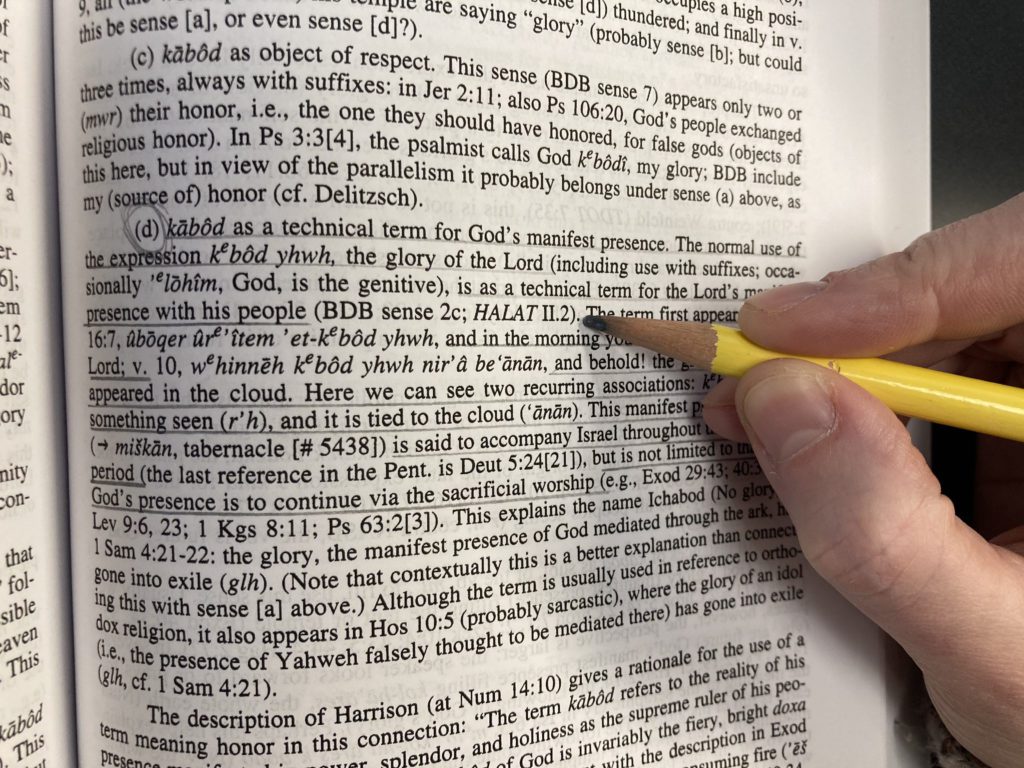
And that’s why I snapped this photo during my studies yesterday: to remind me of this concept of calling.
I was studying the phrase “the glory of the LORD”: we see this throughout Scripture and we use the word ‘glory’ in church settings often enough, but what does it actually mean?
It’s a specific phrase first used by God himself in Exodus, later echoed many times in the Old Testament, and it refers to His manifest presence among people. Whether it’s a cloud above the wilderness or smoke in the temple, it’s a literal representation of the honor and importance and brilliance that is God revealed to us.
—Now, if I read through many multi-page articles and write my own compelling summary that takes all the best scholarship into consideration so that few people could poke holes in my work, I will have done a good job on this side of eternity and helped a few people, but that’s it. I will have missed the full-er point: to respond to what I have learned. If I tried becoming a resident expert on this phrase but had no future encounters with the glory of God, no increase in my respect and awe and wonder of a God who chooses to reveal himself to His people, then I have not fulfilled my calling. I would have come so close yet stopped woefully short. But if instead I take this knowledge and allow it to move me like it did the first time God revealed His glory to a human, then I will, like Moses, fall on my face and worship His goodness.
Your calling, whatever it is, will allow you to keep your faith.