“Can we just pray now? I don’t want to go farther until we pray.”
Mark turned toward me yesterday in the Little Sac Woods Conservation area. We weren’t lost; we had been talking about Drury University’s class FUSE 101: A Life Worth Living, where Mark and I were asked to speak today at the request of Dr. Peter Browning. Mark has been asked to speak in this class for several consecutive years, and I began joining him last autumn.
Before we continued hiking, we prayed for God to speak through us to the students. The class invites practitioners from major religions to speak about a life worth living from their worldview. Our presentation will be followed by representatives of Judaism, Buddhism, and more. Being the sole representatives of Christianity is a tall order.
The class assignment in preparation for our visit was Mere Christianity book 4, chapter 8: “Is Christianity Hard or Easy?” The answer, C.S. Lewis explains, is yes: it’s both. Unlike last year, today I brought up my master’s thesis in which I laid the framework for a “theology of tension,” discussing how Christianity holds truths in tension—starting with the nature of Christ (God and human). Is He mostly God? Mostly human? Christianity accepts that He’s fully both, held together in ways we can’t comprehend. From there, we see some opposites in Christianity that are also fully true.
This truth-in-tension has everything to do with following Jesus: Jesus himself said His yoke is easy and His burden is light; He also said that we have to take up our cross and follow Him to be His disciple. To be His disciple, all we have to do is bring our whole selves to Christ: easy. And yet the hardest thing we could ever do. Lewis points out that getting up and getting on with your day can be easy, but the hard part is to recognize that hundreds of thoughts will immediately rush your brain: “and the first job consists simply in shoving them all back; in listening to that other voice, taking that other point of view, letting that other, larger, stronger, quieter life come flowing in. And so on, all day.” It’s an instant and an ongoing experience. Easy? Yes. Hard? Yes.
Through my research, I didn’t find other prevailing worldviews (religious pluralism and secularism in specific) dealing with life’s tension quite the way Christianity does: they often divorce belief and practice, keeping separate rules for public and private expression, or just write the tension off, placing self at the center of meaning. The subjectivity lends itself ultimately to meaninglessness, with despair as a byproduct. Christianity doesn’t reject the tension or fail to acknowledge its existence: true Christianity inhabits it, pressing on in this space of the already-and-not-yet, of pressed but not crushed, of hope arrived and yet on the way.
I see Mark as, among other wonderful things, a physical image of what it means to inhabit tension: the truth that life is at once beautiful and painful. The truth that so much is out of our control, but we control our choices and reactions. The truth that we are at once healed and waiting for healing. The truth that God’s kingdom will come and has come.
So we went, and we played Mark’s video, and we spoke, and we fielded questions, and we pray that the students will take their questions about tension and truth into the frameworks of other worldviews and see that they come to rest in the One who inhabits the tension, “in [whom] all things hold together” (Colossians 1:17).
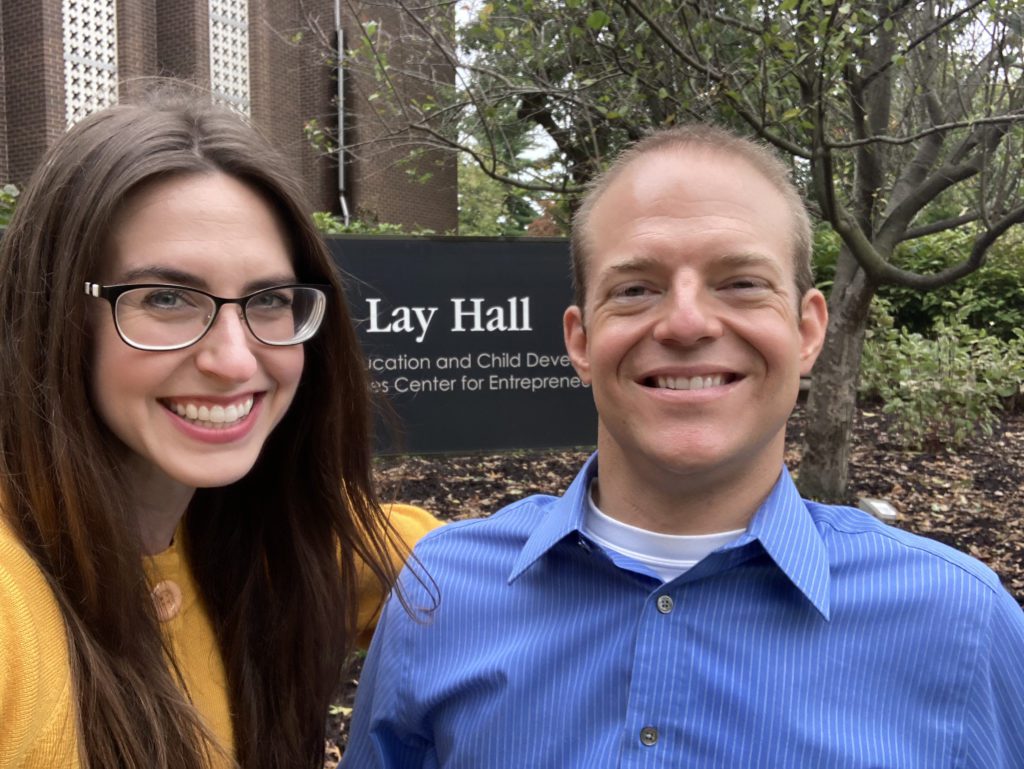
Photos from Drury’s campus but no photos from the Little Sac Woods Conservation area because my hands were full of flint rocks that I collected. (Which reminds me: um, Dear, they’re still in your backpack…)