I appreciate Philip’s lack of faith. Really, I do. It’s the perfect heartbreak and hope for my own condition.
A crowd of thousands had been watching Jesus heal sick people, so they followed Him up a mountainside seeking more (John 6:1-14). Jesus asks Philip, “Where are we going to buy food to feed all these people?” He responds by basically telling Jesus it’s impossible. Yet in a sort of dramatic irony, the gospel writer tells readers that Jesus asked Philip the question only to test him. I always thought that sounded manipulative—until today. Now I see it in a light that brings heartbreak and hope.
Heartbreak. //
The “feeding of the five thousand” story that’s about to ensue appears in all four gospels, underscoring its importance. By tracking Jesus’ miracles chronologically, at this point in John 6 we can gather that Jesus’ disciples have seen Him perform at least 18 miracles. These included turning water into wine, healing physical ailments, calming a sea storm, and even raising the dead. But when it comes to food, a disciple’s gut reaction is to see the situation in purely material terms. He doesn’t sense a spiritual situation at all, instead stressing that even a massive sum of money couldn’t feed each person for more than a few bites.
And that’s where the heartbreak sets in for me: after seeing Jesus *in person* and witnessing miracles that most humans have never seen and will never see, Philip does not instinctively turn to Jesus in faith. The thoughts that come out of His mouth express bewilderment and doubt. Yet he was one who has been personally called by Jesus to be a disciple (John 1:43). This tells me that no matter how many magnificent past experiences I have with Jesus, no matter how many watershed moments, I can still struggle with faith in everyday situations.
For all we say and pray about God having control over the whole world, our knee-jerk responses can reveal that we may actually consider some of life under our jurisdiction rather than God’s — that we actually do split our existence in to what’s “secular” and what’s “sacred.” This episode in Scripture (as well as many others) blasts away that notion. Are there really parts of our lives, even the most mundane, monotonous, mindless parts, that do not require faith? Scripture would teach us otherwise. But how many miracles would Philip need to have seen before his first response to any deficit was faith? 19? 190? That’s not the point.
Hope. //
What gives me hope about this story is not the miraculous outcome; it’s that Jesus tested Philip. Yes, the part I used to despise, now I love because Jesus cared enough to expose a part of Philip’s belief system that needed fixing. I love that Jesus did not correct Philip in this passage; He just let events play out. The disciples had already learned that the wind and the waves obey Him — and now they saw that fish and bread do, too. And this gives me hope because while I have learned that Jesus is Lord over things like my missions efforts and my marriage — the milestones of my life — I’m still learning that He can be Lord over my Mondays and mornings — the recurring parts where my default is to coast. Sometimes it’s easier to trust God in the big things, and in ways I’ve trusted Him before, rather than in the small ones that I don’t think twice about. I gain hope through this story because a test from Jesus is a statement of care, showing the person tested that He cares too much to leave them as they are.
It is likely that after this episode, Philip’s faith grew. Church traditions on the life of Philip vary (this is not Philip the Evangelist in Acts), and some accounts read that he became a missionary to people in several European and Asian countries and eventually was crucified upside down.
As I think about Jesus’ test of Philip, I’m taking inventory of any element in my life I don’t think twice about and inviting God into the littlest of processes and procedures, asking Him to do more with them than I ever could. There truly is no “secular” and “sacred” divide if Jesus is who Philip knew He was (John 1:45-46)—the One the prophets awaited, the One who fulfilled every hope. He’s come to fulfill all of yours, too, and invites you to trust Him in every facet of your existence.
I’m heartbroken over how easy it is to forget to have faith. And I’m hopeful because Jesus intends to grow our faith until it fills up every area of our lives.
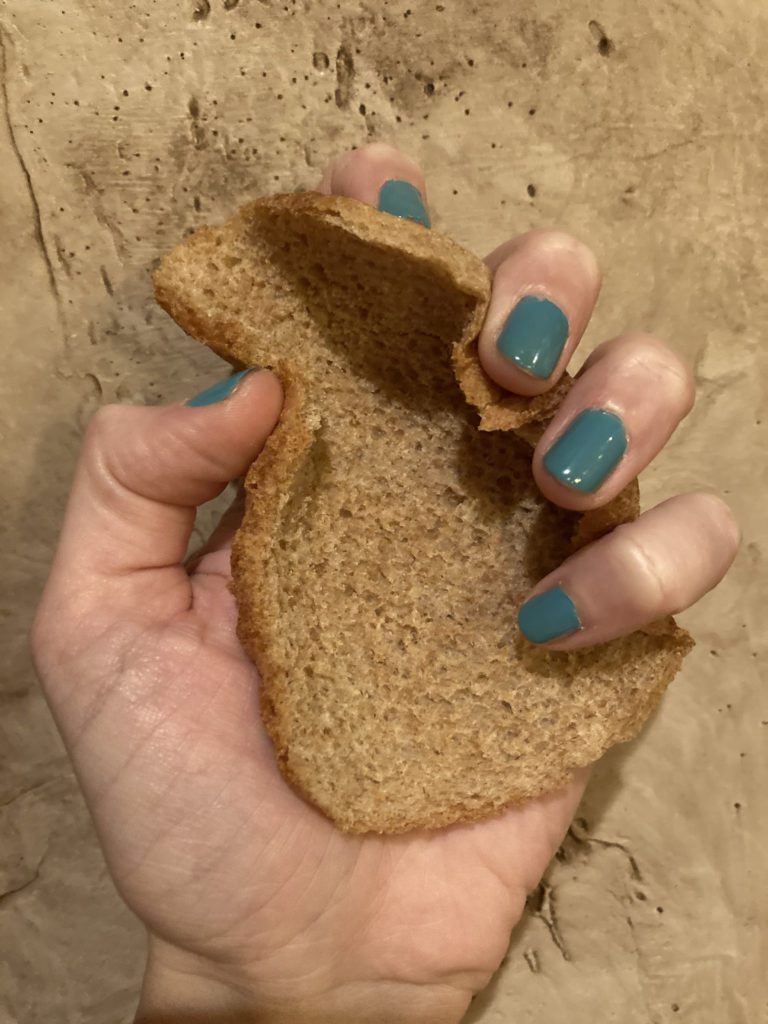
Photo: me crushing a piece of bread as a nod to John 6:7, and no, I did not waste it.